The Man Within
Published 1929
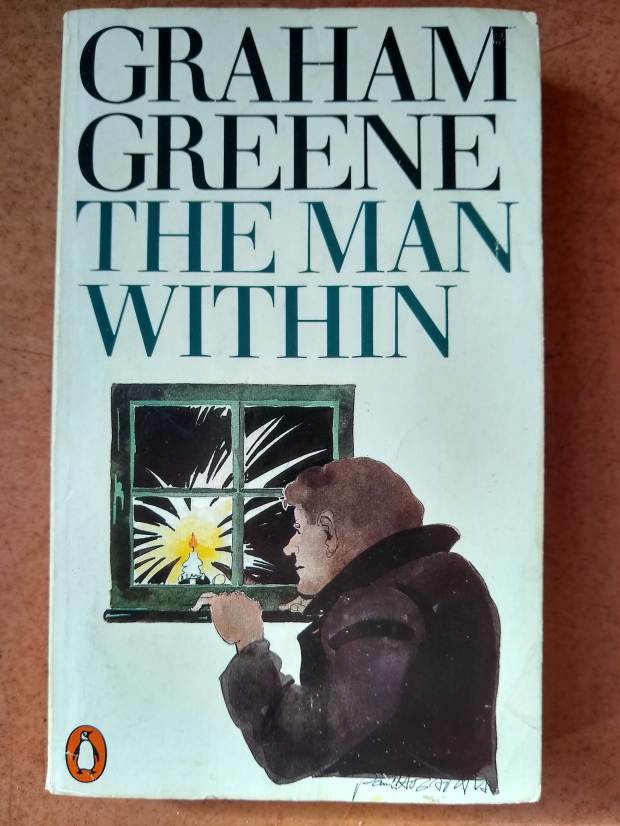
This book led me to think about cowardice more deeply than I have ever done. Andrews, the person within whom the man may be, is a coward of such a degree and at such a visceral level that I would not have considered likely. His cowardice is solipsism. Deep inside, he does not believe that the world outside of his body matters very much and he interprets others’ actions and speech wholly in terms of the mental material of his own cowering inner world. Perhaps his fault is one of degree, as this type of self-centeredness that grows into cowardliness, like an enticing orange that first ripens and then grows mold, is shared by many of us. Unlike many others, even when someone he cares about is in danger right in front of him, he is not able to shrug off this self-centeredness. Thus, wallowing in his cowardice, he avoids basic obligations to those around him.
The story takes place on and near the south coast of England. Andrews betrays his smuggling comrades, including his close friend Carylon, the leader of the smugglers, to the police. In the ensuing scuffle, Andrews and some of his erstwhile friends get away (separately) and a police officer is shot. Thus, his comrades are on the hook for a capital crime and Andrews is on the run from his friends. And he is correct to be terrified of meeting the three who got away, which number includes Carylon. Tumbling over the downs feeling afraid and sad for himself, Andrews meets Elizabeth, who is quite wise and all-understanding for being nineteen. As their connection develops, Elizabeth lends Andrews some of her conscience and he is able act bravely a couple of times (although not without a lot of fearful foot-dragging). However, when his smuggling ex-buddies threaten Elizabeth, hoping to lure him to them, will this donated bravery be enough?
Elizabeth and Carylon stand as a counterbalance and challenge to Andrews and his cowardice. These latter two characters both possess consciences and senses of duty (except to pay duties, in the case of Carylon…) that enable them to act according to their pre-established moral codes in the face of fear. One of the few things that is to Andrews’ credit is that he recognizes the moral superiority of Elizabeth and Carylon and wishes to follow them. Less to his credit is that he expects both to provide the will and to make a way that he will then meekly walk down. At no point does Andrews show any moral initiative.
The end certainly surprised me. Luckily I had not read the back cover of my edition of the book, as it gave away the most surprising part of the ending…
*
In the Author’s Note at the beginning of the reprint edition, Greene says that he prepared a revised version, “but when I had finished my sad and hopeless task, the story remained just as embarrassingly romantic, the style as derivative, and I had eliminated perhaps the only quality it possessed – its youth.” The book was then reprinted unrevised.
I cannot speak to how derivative the style is, as I not have read the sources Greene gleaned.
The characters do act according to a romantic understanding of themselves and their relation to the world. Andrews at times explicitly uses overwrought romantic phrases as he tells himself how miserable his fate is. A romantic fatality also drives Andrews relationship with Elizabeth and with Carylon.
The manner in which Andrews resolves his psychological difficulties, the moral perfection and foresight of Elizabeth, as well as the entire character of Carylon, who coincides in reality with the image of him in Andrews’ head, are not of the mundane world, but rather of a numinous world of banalities. Still, their combination was bound to provide a compelling story, and this one also develops enough suspense to have made me anxious to read what would happen next.
 Mad Scribble