Brighton Rock
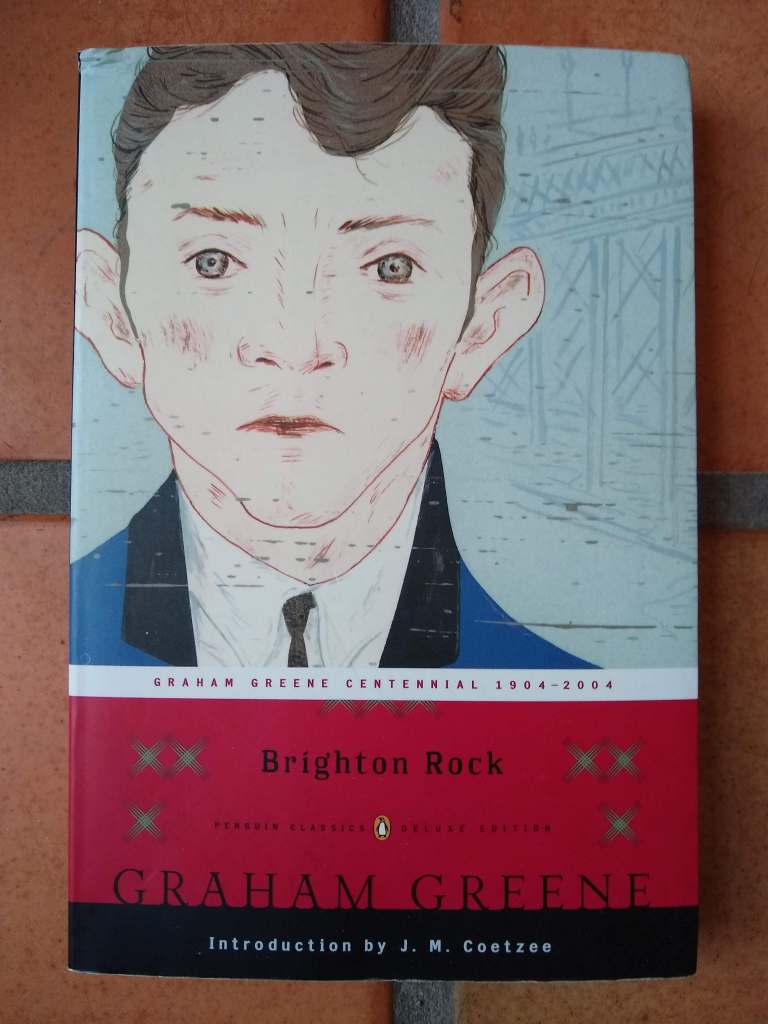
Greene’s ability as a writer has blossomed in this book into a terrible mastery. A darkness of vision that borders on cynicism animates the characters. At times Greene seems to use his power to forge a perfect pain for the characters. One despairing character (mis)quotes Marlowe’s Mephistopheles, “Why, this is Hell, nor are we out of it.” Greene seems inclined to agree.
Pinkie grew up Catholic and once wanted to be a priest. After rivals assassinate the previous leader, Kite, Pinkie finds himself in charge of a moribund gang operating a protection racket in Brighton. But Colleoni’s gang is moving into town and is pushing Pinkie’s crew out. The threat of Colleoni is an important background to the story, but that is not the source of the drama that makes up this novel.
Pinkie’s crew murdered a man, Fred, who had some murky connection to the death of Kite. It was a clean murder. The inquest declared the cause of death to be a heart attack. It should have been smooth sailing, except for two people: Rose, a girl who worked at a restaurant and who saw something damning, and Ida, a larger-than-life lady who spent some time with Fred before he disappeared and then turned up dead. The book focuses on how Pinkie covers up the murder and how Ida seeks to uncover it, with Rose in the middle, ever ready as a sacrificial lamb.
In this book, more than in any of Greene’s novels so far, the characters are quick, made of flesh and filled with blood. Ida is magnetic. Buxom, vivacious, confident and continuously burping up Guinness. Her thinking is intuitive, yet entirely grounded in this world, careless toward death and ignorant of any spiritual meaning. With the Devil reigning in Heaven, Ida is an angel of the Earth. She quickly establishes herself as the good gal, the foil to evildoers, who will stand up for what is right, even if she has to go it alone.
Pinkie is clearly the bad guy, relentless and paranoid. He will betray anyone, hurt anyone, even kill anyone if it will protect him. He is evil. He has a deep, although implicit, religious conviction. He understands what sin is made of and, if circumstances make it advantageous to sin, he embraces sin. Pinkie is also vicious. That is, he wishes to hurt more than is necessary to get what he wants.
Pinkie is also only seventeen. He is a boy scared of growing up, but a boy whose brutality lands him in the position of a man. He is unsure what to do next. He is trapped. And now he is moving too fast, going too far, and doesn’t know how to stop. He has a puritanical abhorrence of sex but, in order to prevent her from being able testify against him, plans to marry Rose.
Rose has no thorns. Deeply religious, she is ready to drown her innocence in Pinkie’s sin. Pinkie is not good to her, although he feigns affection at times. But Pinkie and Rose come from the same slum background and share a belief in Catholic morality that remains unshaken even when they choose to violate it. From the beginning, the secrets they share are what unite them. Rose fits their actions into a mythological framework that makes meaning out of even Pinkie’s deeds, but Rose’s psychodrama will last until past the end of the book.
*
This book is disturbing. Hell is on Earth. It may be where we come from, it may be what we build around us. Brighton, town of the weekend debauch, provides affordable pleasure to some, pains that cost a soul to others. Ida, lady of the World, cannot see Hell and so cannot reach Pinkie and Rose. These latter know how far they are from God and recognize the Hell around them.
 Mad Scribble