The Confidential Agent
Published 1939
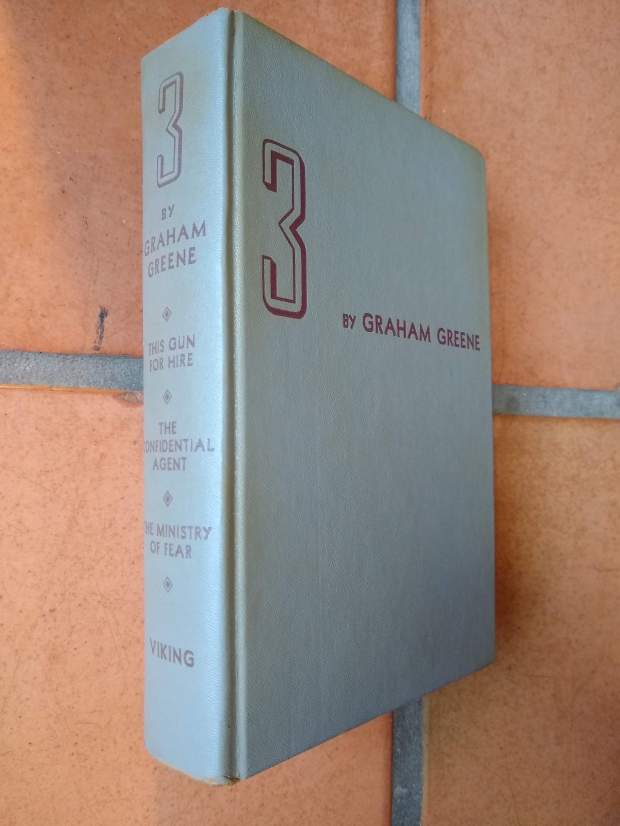
This book reads like a noir movie. Greene wrote this months just before the beginning of World War II. It seems like a bookend whose counterpart will be The Third Man, which takes place immediately after the end of the War. A constant theme in the book is the strangeness of being in a country (England) untouched by war.
A middle-aged man in a cheap suit, with ideals but no hope, lands in England with a mission to purchase coal for his government. However, D.’s country is wracked by civil war and the Rebels are trying to thwart his mission and buy the coal for themselves. He cannot even trust the members of his country’s embassy, as the Rebels have infiltrated almost all levels of government. One might assume that D.’s country is Spain, but other clues would hint at somewhere in Central Europe, always a good location for mystery and misery in the Anglo-Saxon imagination.
Waiting for the train to London in Dover station, D. meets a flash young lady who happens to be the daughter of Lord Benditch, the man from whom he intends to purchase coal. They strike up an acquaintance that leads to the young lady falling in love with D., despite the fact that he tries to steal her car later that evening in order to get to London before his rivals. Once he gets to London, it seems that none of his contacts are trustworthy, as they are either already working for the other side or they are shopping around for a good price to switch to the rebels. Despite D.’s extreme caution, he fails in his mission.
Greene does a good job building up the importance of D.’s mission and the grim consequences of failure. When D. fails and the one person who has been helping him is murdered, something inside of D. snaps and the reader can understand why. The second part of the book involves D. trying to get revenge on those of his countrymen who betrayed him. But D. was an academic, a specialist in Romance Languages, he is not a spy and he is not a killer. Good at strategy, D. can corner his target, but he cannot execute. With the help of a somewhat ridiculous deus ex machina, he does partially succeed in his revenge. And the book ends with the most conventionally happy ending Greene’s novels have provided so far.
*
In J.M. Coetzee’s introduction to Brighton Rock, he mentioned the ways in which cinema influenced Greene’s writing style. How the scenes are described as if from specific camera angles, how scenes fade in and out, beginning outside the room where the action takes place, or ending with a description of the view outside the window. I perceive these methods in The Confidential Agent much more than in Brighton Rock. This book’s scenes are tight and location bound, with specific angles of sight provided in the narrative. When D. walks the streets of London, predator or prey, it feels as if we follow him with a camera on a track. The ending of the book particularly projects an image from a noir movie: a man looking out to sea, a voice heard and unexpected, a woman walking up from the shadows behind. Cut to credits and music.
 Mad Scribble