The Heart of the Matter
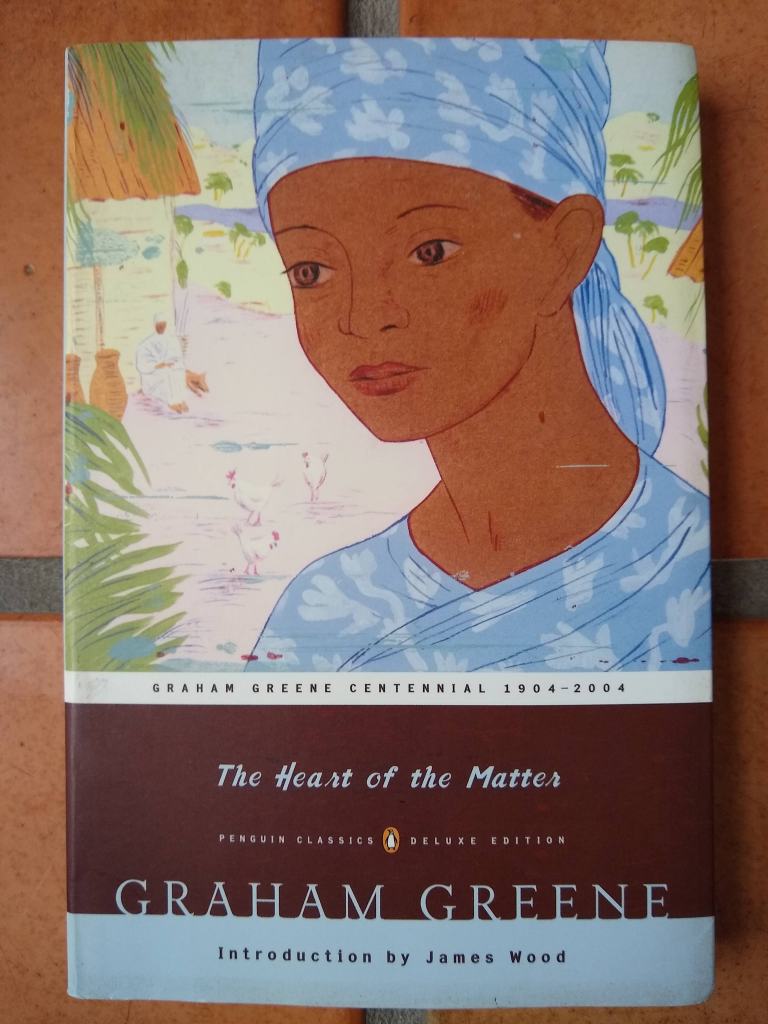
Published 1948
An honest man betrays the ideals that everyone admires in him by adhering to ideals that do not make sense to anyone, including those he seeks to protect, and that he himself believes will cost him his soul. He operates with the greatest gravity, weighing his every action, hiding his intentions and trying to clean up the mess he is making. Those around him see through his subterfuge, but cannot fathom his thinking.
Scobie is an honest police officer in the British colony of Sierra Leone (this is never said, but that’s clearly the setting) during WWII. The entire colony knows his honesty and sense of duty. Everyone is upset for him when he is passed over to be the next police commissioner.
Louise is Scobie’s wife. She is a great lover of poetry and because of this and for other, never fully specified reasons, most people in the colony find her to be insufferable. She is aware of this and miserable. When Scobie is passed up for commissioner, she insists on going to South Africa and expects Scobie to find the £200 that that requires.
Scobie takes a loan from a disreputable Syrian, which, by itself, was not a betrayal of his honesty and duty. But one thing leads to another…
Along with a few others, Mrs. Rolt washes up on the African coast, the survivor of a boat sunk by the Axis. Newly widowed, a year out of school, she finds herself living in a Quonset hut alone. Scobie helps with the legal formalities of recording and rehoming the survivors. He brings Mrs Rolt some furniture and makes sure she’s settled in. But she needs him. She holds tight to him and demands him of himself. And one thing leads to another…
Scobie is incapable of feeling love for another, only pity. He acts out of pity and he learns to lie out of pity. As the story progresses he recognizes that his pity puts him in situations that hurt those around him. He then acts to protect the women in his life from himself.
This book is similar to Brighton Rock, in that it centers around a Catholic protagonist who believes with great faith that he is damned. The difference, of course, being that Pinkie was from beginning to end reprehensible, whereas Scobie is at first admirable, then pitiable, and finally irretrievable.
I have recently studied some classical history. Christianity germinated in the pan-Hellenic culture of the Eastern Mediterranean under the Pax Romana. This period was one of tremendous religious variety and innovation, with many religious beliefs spreading across the Empire, evolving in contact with new believers. Despite the avowed intolerance of Jews and Christians towards other religions, they also formed within this Zeitgeist, borrowing, in the case of the Christians, many Platonic and Stoic beliefs (“In the beginning was the Word…”) as well as much of their ceremony, art, and organizational structure.
Although I was Catholic as a child, I find the beliefs that define the spiritual worlds in which the protagonists live in some of Greene’s novels to be arbitrary and bizarre. I suppose many Catholics believed these things back then, maybe some still do, but they are so culturally alien to me that I have had to make a conscious effort to take them seriously enough to be able to understand the motive forces within Greene’s books and not just find them laughable or obscure. This is where seeing Christianity, and Catholicism in particular, as just another religion that evolved in the Roman Empire, provides the perspective I need to take the beliefs of Scobie serious as psychosocial facts that guide behavior.
What makes the religious dynamic in this book more interesting to me than it was in Brighton Rock is that other characters in the book, particularly Mrs. Rolt, find Scobie’s beliefs as strange as I do. In other words, these beliefs were already alienating in the period of the book. It has sometimes seemed to me that religion sometimes demands of its adherents a belief in something clearly ridiculous as an act of faith. That is, one must demonstrate a willingness to believe in something that we know is not true.
There are many problems with this book. Scobie constructs a spiritual torture chamber for himself with a single exit: damnation. The drama only makes sense in Scobie’s head. All of the other characters and the reader are left wondering: Why did this happen? One must have a touch of carefree sadism to enjoy this book.
This was one of the books that made me want to read all of Greene’s works. I read it over ten years ago and had forgotten many parts of it, which allowed me to rediscover this masterwork.
 Mad Scribble