The Quiet American
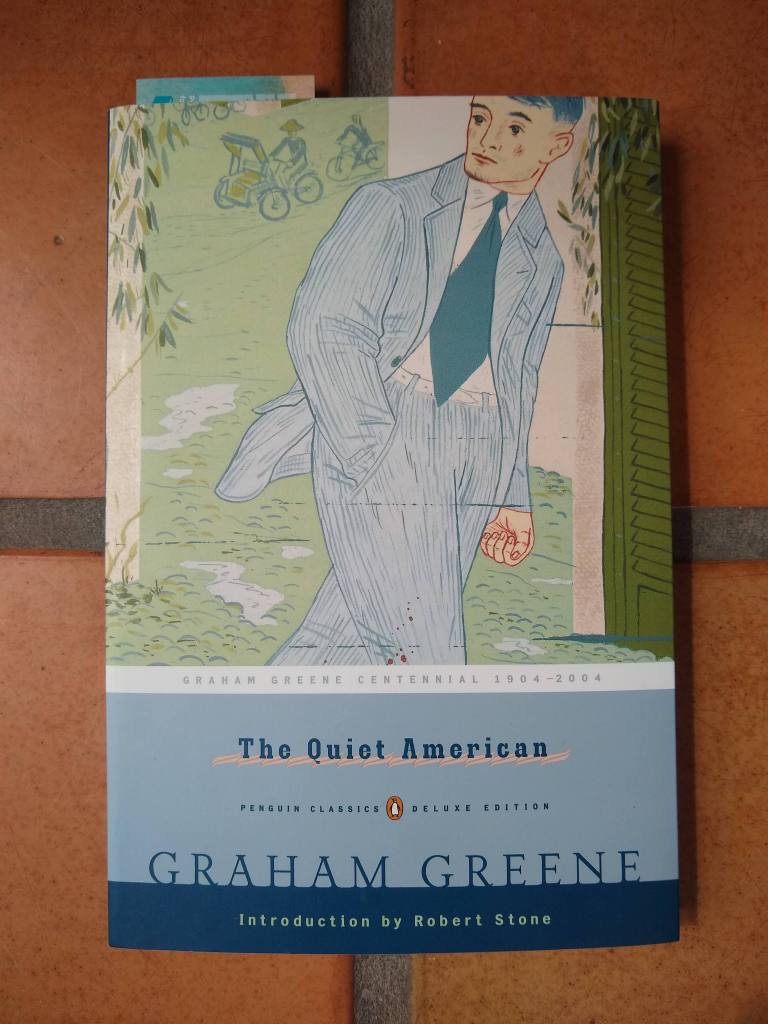
Published in 1955
This book is magnificent. Pyle is a young, overly educated, highly righteous American in Vietnam during the final years of the French war to hold on to their colony. He befriends a middle-aged, jaded, opium-smoking British journalist and woos away the latter’s beautiful Vietnamese mistress. Fowler never returns the friendship, but their paths often cross and Pyle never takes offense or even notices Fowler’s bileful jibes, so their connection remains friendly by default. But neither Pyle nor, as it turns out, Fowler are as harmless as they appear.
This book is a delicious mixture of spy novel, exploration of the empty morality of colonialism, and moral anguish in the Graham Greene style. As an American, it is also very interesting to read a novel that takes place during the French war in Vietnam and prior to the full-fledged American war. Although, the patterns of thinking that would damn us there were already in place and working their self-destructive magic.
From the beginning, the book makes a distinction between French colonialism and American anti-Communism. By the end, the reader isn’t so sure what the difference is and which will fail harder. While it seems correct to say that that was a prescient sentiment in 1955, the year the book was published, perhaps it is more correct to say that American involvement in Vietnam was clearly delusional from the beginning, for anyone whose mind hadn’t been destroyed by the likes of York Harding.
One shining characteristic of this book is the nuanced satire on Americans and American manners that Greene employs, demonstrating a deeper understanding of America than he had in previous books, such as the Power and the Glory. In his journeys to Santa Monica, Greene must have learned much about the American combinations of optimism and rigid ideology, of open-mindedness and ignorance about the world. York Harding is an author whom Pyle has read religiously and who has provided Pyle with an unshakeable creed of how the world works and how to intervene in Vietnam. York Harding, of course, only stopped in Vietnam once on his way elsewhere, but his American common sense and fierce anti-Communism allowed him to see at a glance what Vietnam needed.
At the beginning of their connection, Fowler didn’t know why Pyle was in Vietnam. He figured that Pyle might be there for secret purposes but he prided himself on not being engagé and had never sought to find out. He saw enough of war to know that he hated war, but brutality was not a European or American monopoly. But as a French pilot who illegally took him along on a bombing mission told him, “It’s not a matter of reason or justice. We all get involved in a moment of emotion and then we cannot get out.”
And Fowler does get involved. He chooses and he gets everything he wants.
*
This book is anti-war. In particular, the French pilot who Fowler meets in the North gives an eloquent explanation of both the pointlessness of the French war there, which he knows is unwinnable and its demented cruelty. The worst is dropping napalm. He feels like he’s dropping it on the village in France that he’s from and he sees his father’s friend, the baker, running away under his plane, in flames, screaming.
During the 1950s Greene worked as a journalist. He went to areas considered dangerous: the hot areas of the Cold War. This book contains many details that are journalistic and while Fowler, Pyle, and their confused relationship are clearly fictional, much of this book, and the anticipation of American intervention in Vietnam are depressingly non-fictional.
 Mad Scribble