Twenty-One Stories
Published 1954
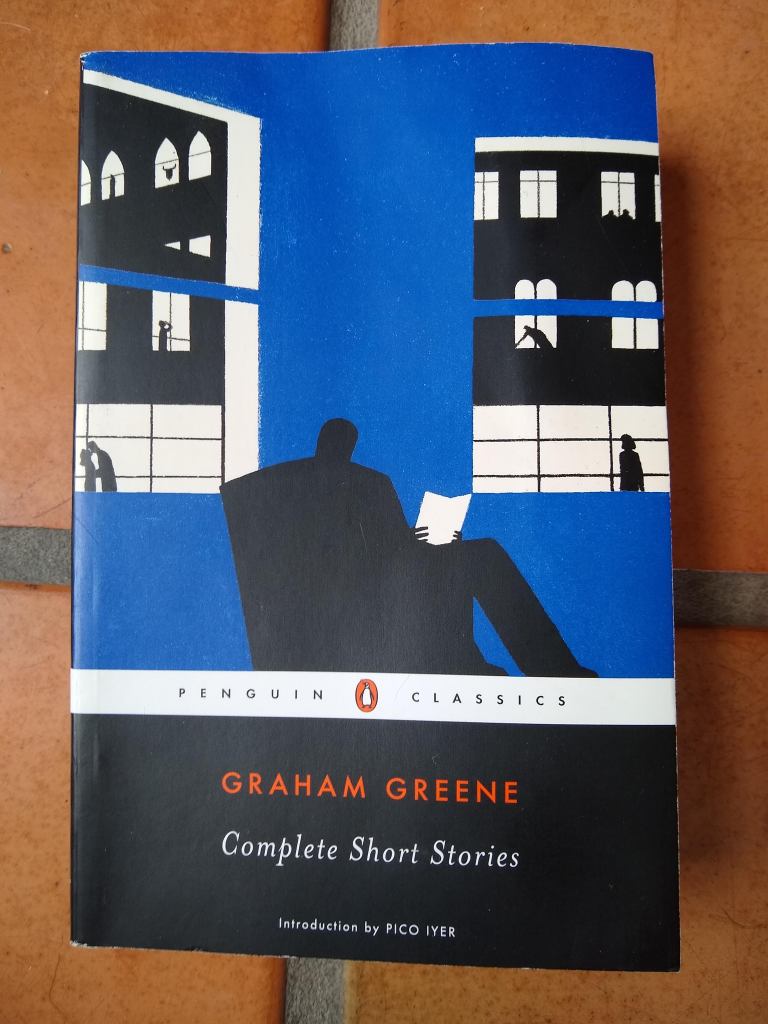
This collection contains all but one of Graham Greene’s short stories published between 1929, his first, and 1954. The collection arranges the stories in reverse chronological order. These are a very eclectic lot, with stories that feel like either scenes that never made it into one of his novels or were prototypes for a scene that did make it into a novel and stories that stand on their own. Finally, the collection includes several stories that are much more fantastical than anything he has included in a novel. Some of these stories are clearly in the style of Poe, with the dismal distinction of taking place in the shabby environs of mid-Twentieth century London.
The stories that stand on their own include “The Destructors,” a well-written, though dreary, story about malevolent children in post-War London, and “The Basement Room,” which was turned into the 1948 film The Fallen Idol. This latter was perhaps the second most successful film based on a Graham Greene book, following The Third Man. Carol Reed directed both films.
The story “The Innocent” is an anecdote that never fit into a novel, although it feels like it comes from one. A man returns to his childhood village with a lover, but is overwhelmed with the memory of his first love and the little notes he would leave her. When he happens to find one of the notes, still preserved in the hollow fence post he put it in, he is disillusioned about himself and his memories.
Stories that were clearly inspired by the same sources that fed his novels include “The Blue Film,” a short and piquant sexual farce set in Saigon; “Across the Bridge” draws from Greene’s time waiting for a car that never showed in a Mexican town on the Rio Grande; and a prototype for the climactic final scene of Brighton Rock is found in “A Drive in the Country,” while “Jubilee” could be a missed connection of Brighton Rock’s Ida Arnold.
Two stories from 1940 provide a look at the life in London during the Blitz. “Men at Work” describes the stolid continuance of bureaucratic inefficiency, ineptitude and back-stabbing even as the bombs fall across London. It is dryly funny. Whereas “Alas, Poor Maling” is a hilarious story about a man whose borborygmus begins to imitate air-raid sirens and costs him his job.
What makes this collection surprising, however, is that Greene allows his imagination more freedom of expression and some of the collection’s best stories, perhaps because I did not expect them, were horror stories. “A Little Place off the Edgeware Road” and “Proof Positive” are excellent. The revenants in these stories find themselves, of course, in Greeneland and do not understand what is going on any more than the horrified onlookers do. They’re both quite friendly and, in the second story, trying to help society in their own way. Other stories in this vain, include “The Case for the Defence,” “The Second Death,” and “The End of the Party”.
This collection is well worth your time. It shows a side of Greene’s ability that does not come out in his novels and travel writing.
*
He published four collections of short stories. I will be reading three of them this month. The remaining two this month are A Sense of Reality and May We Borrow Your Husband?
 Mad Scribble