In Search of a Character: Two African Journals
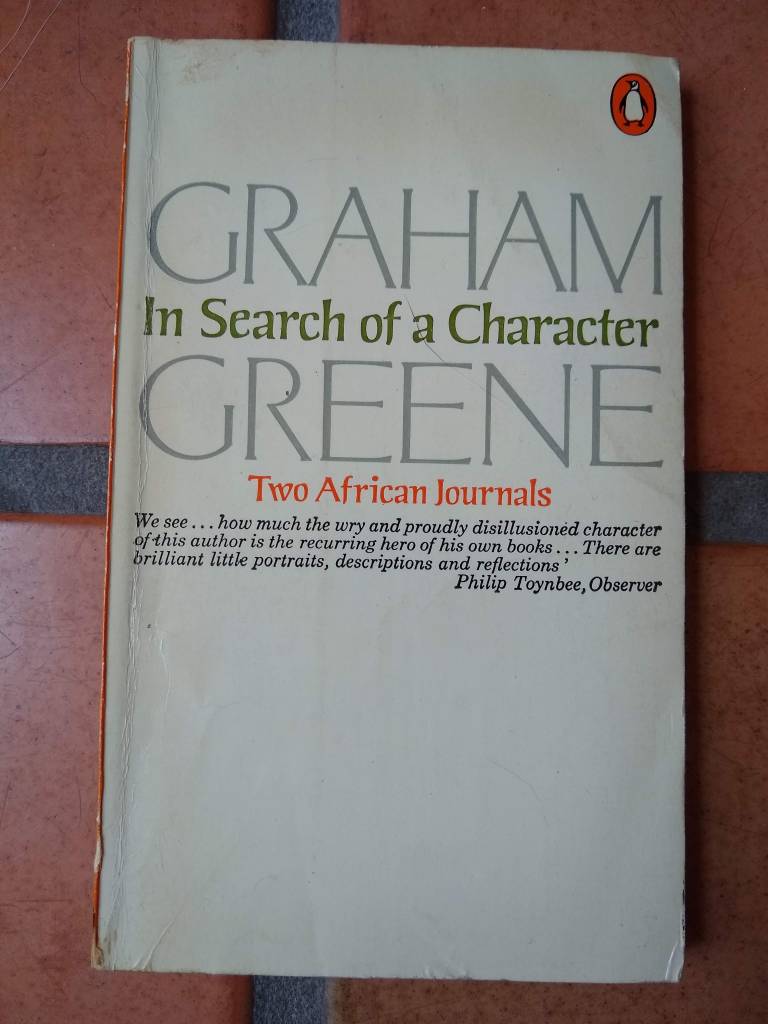
Published in 1961
This brief book combines two travel diaries from different eras. The first and more substantial diary, Congo Journal, comes from Greene’s trip to the Belgian Congo while doing research for the book that became A Burnt-Out Case. The second diary, Convoy to West Africa, describes Greene’s travel by ship to Sierra Leone as he began his wartime intelligence career.
*
When Greene traveled to the Belgian Congo in early 1959, the civil unrest that would lead to independence in 1960 had already begun. He was there to research a book for which he knew only that a man turns up at a leper station. For those who have read A Burnt-Out Case, several of the situations and characters in the journal will be familiar, as Greene borrowed some of them entirely. What is more interesting are the directions he imagines taking the book that he never did. Greene has added several footnotes that explain some of reasons for the changes he made.
The journal is also a true travel diary, describing his stay in Léopoldville (soon to become Kinshasa), his journeys by river boat, and his stays at leproseries, and among the colon communities. Wherever he goes, however, he records interesting or amusing situations that occurred, jotting down memories to hold on to.
We get a glimpse of how Greene wrote. He writes possible situations and scenes from his future book as they came to him, seemingly as a way to help himself understand the characters. Some of these remain in A Burnt-Out Case, some of them don’t fit the final form the characters took, and some seem like imperfect prototypes for scenes that do occur in the book. However, at this point Greene had not begun to write the book. That is the dangerous moment, as Greene relates in a note: “The beginning of a book holds more apprehensions for the novelist than the ending. After living with a book for a year or two, he has come to terms with his unconsciousness – the end will be imposed. But if a book is started in the wrong way, it may never be finished… So one hesitates a long time before taking the plunge – whether one is to sink or swim depends on that moment.”
If you like A Burnt-Out Case, then you will find this journal interesting. Otherwise it would be difficult to follow, as the novel provides more context than this telegraphic journal.
*
The second journal is of more historical than literary interest. It’s an almost day by day account of the journey from Liverpool to Freetown, Sierra Leone, from December 9 1941 to January 3 1942. Ship travel during the War was in convoys and so they move down the Atlantic coast of Europe and then Africa together with a convoy of other merchant and navy ships. The ship Greene is on holds a motley group of people on official business, such as Greene, and business men and scholars. Greene has to do a watch each day, keeping a look out for Axis ships.
Fear pervades the entire journey, as a German submarine attack is a very real possibility, with ships being lost each month. Fear is better borne with others, so the conversation on the ship is general, with everyone drinking, eating and carousing together each night.
This was the beginning of Greene’s wartime experience in Africa that would provide material for The Heart of the Matter. Only in a couple of cases does it seem that Greene drew inspiration for his book from one of his companions on the ship. At one point, they are terrified by a ship on the horizon that turned out to be a Portuguese ship (the Portuguese were neutral during the War). He adds a note that Portuguese ships would be his bane for much of his time in Africa, since he would receive intelligence about diamonds being on board, but was never able to find any. Scobie in The Heart of the Matter had to deal with the same issue.
 Mad Scribble