The Comedians
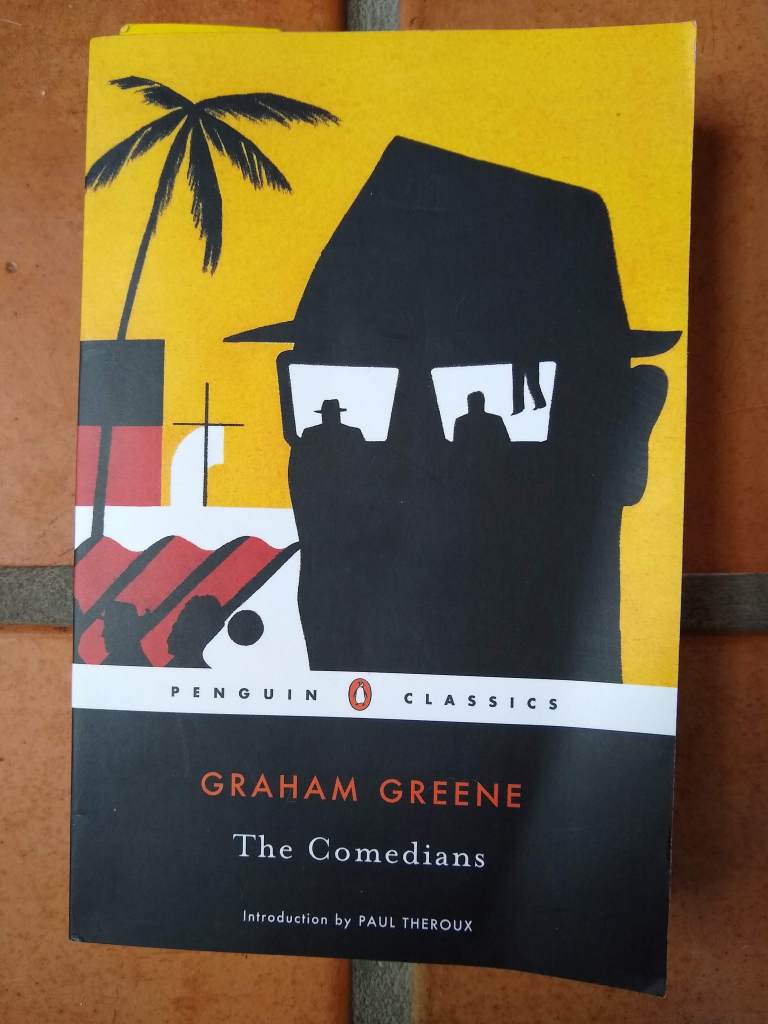
Published 1966
Haiti under François Duvalier, Papa Doc. The military tried to overthrow him. Now all the generals are dead, in jail, or have fled to Miami or the DR. Order is maintained by fear, fear is maintained by the Tontons Macoute, or bogeymen in Haitian. The Tontons do whatever Papa Doc asks and take great pleasure in torturing enemies, real, imagined, or convenient of the regime. With this somber background, rogues and saints meet in Port-Au-Prince.
This is a difficult book. The longest Greene novel so far, the action moves more slowly, the characters evolve more smoothly, without the unexpected jumps with which his characters develop in previous novels. The narrator and protagonist is likeable and has a nuanced view of the world. But over the course of the book we begin to realize that he’s a selfish bastard and perhaps not so reliable a narrator. Mr. Brown unmasks himself in the book. Brown also seeks to unmask the other characters close to him because he assumes that all those around him are comédiens, playing roles, changing who they are when they are around others.
*
Brown runs the Hotel Trianon in Port-au-Prince that was successful until recently. Now, the tourists have fled and Haitians stay home, terrorized by the Tontons. Brown tried to sell the hotel in New York, but couldn’t find a big enough fool. On the boat back to Haiti he meets Jones and Mr. and Mrs. Smith, all bound for Haiti. The Smiths agree to stay at Brown’s hotel.
Mr. Smith and Mrs. Smith are conscientious and earnest people. They are very proud of how much they care about Black people and never tire of telling anyone of the punches they took during a civil rights march in Nashville. They are also devoted vegetarians and have come to Haiti on a mission to open a vegetarian center in the country. They have a letter of introduction to M. Philipot, the Secretary for Social Welfare.
Unfortunately, M. Philipot is lying dead next to the pool of the Hotel Trianon. He slit his wrists after hiding in the hotel for some days from the Tontons. He had fallen out with Papa Doc. Brown gets help from his good friend, Dr Magiot, to find an inconspicuous place to dispose of the body.
Brown doesn’t like Jones from the beginning. He can spot a flim-flam man when he sees one, having been one himself. He’s not surprised to hear that Jones was arrested as soon as they arrived. He’s slightly more surprised to find out that Jones got himself out of jail and is now living it up working with the Tontons. He apparently convinced them that he can get them American money and perhaps weapons.
Tonton Captain Concasseur is Jones’ handler, but he’s not entirely convinced by him. When he goes to Miami to check on some of Jones’ supposed funders, Jones knows he has to go to ground. Brown helps him into one of the only safe places they can think of: the embassy of Ambassador Pineda.
Ambassador Pineda represents an unnamed Latin American country. He is friendly and has a lovely wife, Martha. Brown reconnects with Martha, his mistress, shortly immediately after returning to Haiti. When Jones moves in to the embassy, Brown is consumed by jealousy.
In some ways the ending of the book resembles The Quiet American, with the protagonist doing away with the rival for his mistress. However, Fowler acted out of conviction that Pyle was doing evil. That Fowler ended up getting everything he wanted in the end was due to chance. In this book, Brown acts in perfect selfishness, although he exposes himself to great danger in order to get rid of Jones. In the end, Brown is a rogue and Jones a hero.
*
The book repeats a phrase twice: “this was a century in which old men lived beyond their time.” It has two different meanings in the book. In one part it refers to Papa Doc and how, even though old, he may yet live a long time. In another part of the book, it refers to Brown and Dr. Magiot and how the world doesn’t make much sense to them anymore. The two sides of this phrase hang on the fact that the world in the mid-Twentieth century was changing very rapidly. For most of those who could not keep up, the world passed them by. For those few who held power, they could try to arrest the movement of the world. Papa Doc froze Haiti in time to make it easier to control and to ensure his personal safety.
One motif in this book, which is surprising in a Graham Greene novel, is the relative perfection of some of the characters. Martha is a paragon of virtue: a perfect mother, a faithful mistress, with great understanding of human nature. Mr. and Mrs. Smith may be ridiculous, but their honest desire to help the world is unquestionable. Finally, Dr. Magiot is a man of great faith in man, reliable and honest. What distinguish these four from Brown and Jones is that they are not comédiens: the only role they play is themselves.
 Mad Scribble