Travels with My Aunt
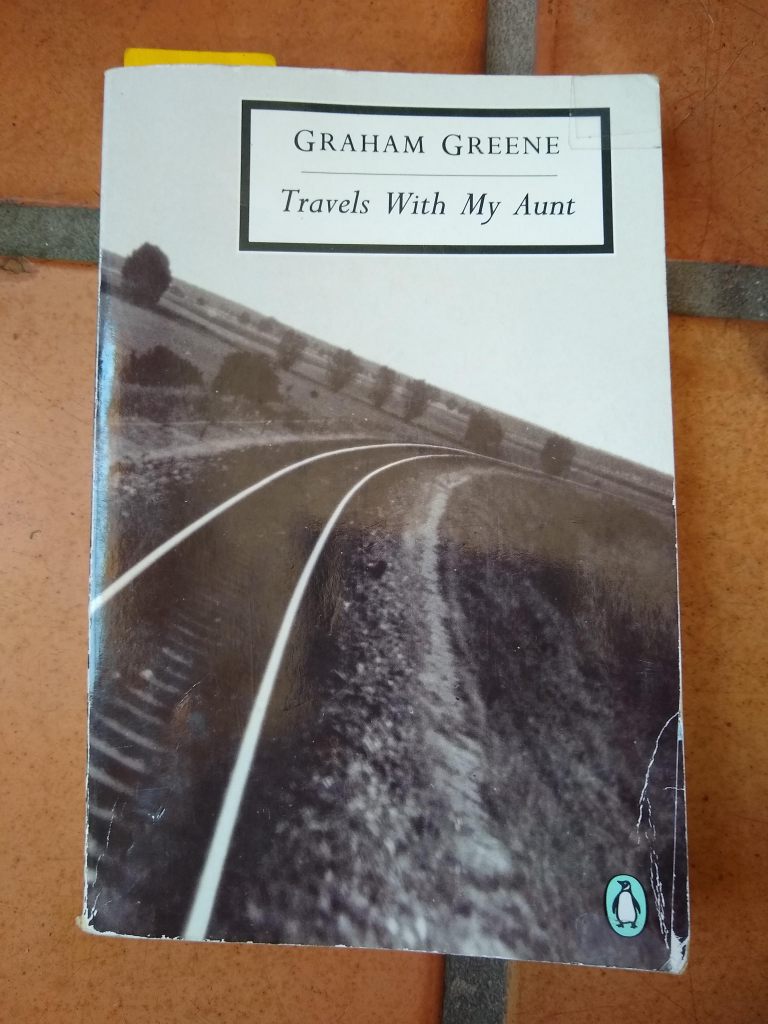
Published 1969
Henry Pulling is a dull man. Retired early from a bank, he spends most of his time pursing his only interest: growing dahlias. But, his routine is broken when he attends his mother’s funeral. There he meets his Aunt Augusta, someone he never remembered meeting before. Aunt Augusta’s life has contained more than dahlias and she has the stories to prove it. Now that she has reconnected with Henry, she seems determined to drag Henry on her adventures. Will Henry be able to keep up with her or will his garden and armchair root him to the London suburbs?
She lures him first with a weekend in Brighton, where she shares some unusual stories about her past, including the time she was deaconess at a church for dogs and how she worked with a traveling company of girls for a Mr. Visconti in Italy. Henry assumes she was an actress.
Henry’s connection with Aunt Augusta escalates, and he finds himself helping her smuggle cash out of England, and on the Orient Express, destination Istanbul. Aunt Augusta says she has business to do there. He is quite out of his element. On the train Henry meets Tooley, a hippy girl, making her way to Kathmandu or Vientiane or somewhere where the people are really alive. While Henry finds Tooley stimulating, he can only act as a father figure for her. And when Henry meets her father later, they connect over both having served as a father for her.
Unfortunately, Aunt Augusta’s contact in Istanbul, General Abdul, has just been shot by the police. Colonel Hakim quickly deports Harry and Augusta back to England. But even more unusual adventures are to come. Mr. Visconti is alive and Aunt Augusta is going to find him. Interpol is also trying to find him, since he is a war criminal. That means, of course, destination: Paraguay.
*
This book is the most comedic of Greene’s books so far. While Our Man in Havana was a comedy, the jokes took place against a background of violence with the possibility of nuclear war. The comedy of this book is pure. In fact, the plot of the book seems like a narrative device to deliver a variety show of amusing anecdotes and jokes.
One of the on-going sources of amusement is Henry seemingly being in the dark about several key aspects of Aunt Augusta’s past. In fact, it’s only on the second to last page that he reveals that he has realized the most important secret, which the reader guessed long before.
Most of Greene’s novels make greater or lesser use of Catholicism. In some books, the strong Catholic beliefs of one of the characters determines much of the plot. However, in this book, the lapsed-but-not-forsaken Catholicism that Aunt Augusta brings out from time to time as suits the occasion becomes another one of her creative stories, whose weave includes threads of truth and fantasy and even she has forgotten which threads are which.
*
I read this book for the first time in high school. It was the first of Greene’s books that I read. I enjoyed it then, but many of the references and humor went over my head. This book shows a side of Greene that we have only gotten glimpses of. It is as if Greene let go of Eternity when he wrote this book. So many of his other books wrestle with the eternal consequences of actions and beliefs. If this book has a point (doubtful), it is that we should push hard on life and that the worst that could happen is that life pushes back.
 Mad Scribble