Ways of Escape
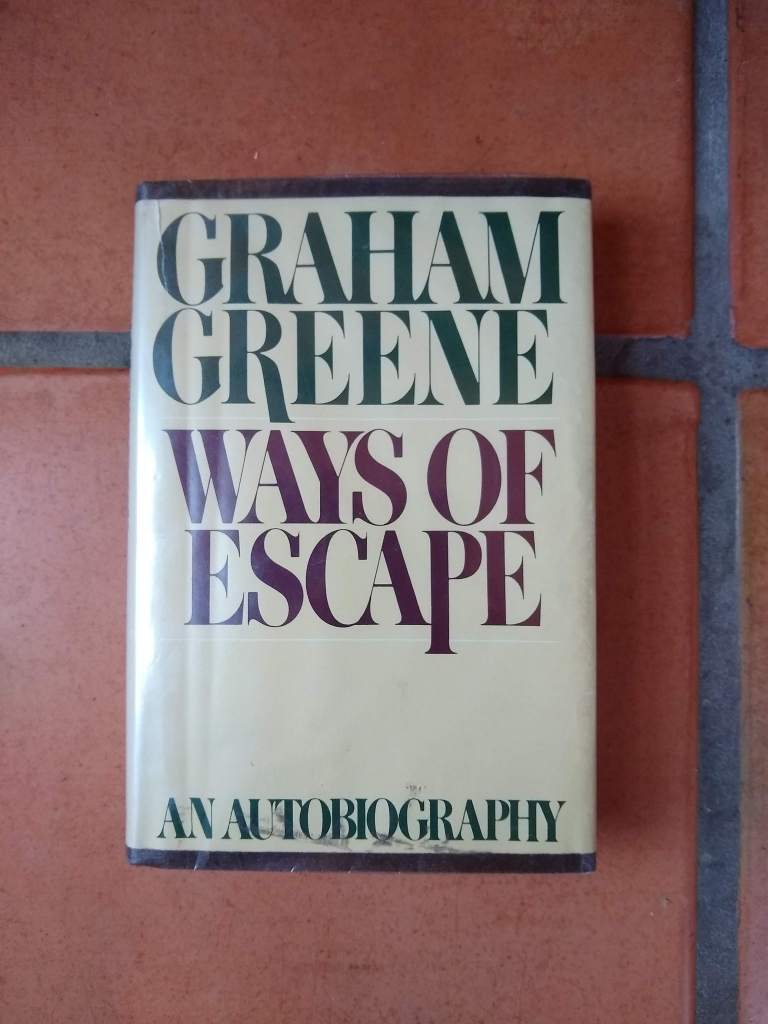
This is a much more interesting book than A Sort of Life. In this second book of autobiography, Greene gives us juicy anecdotes, often serious, sometimes wryly humorous. In contrast, A Sort of Life read like a biography of Graham Greene by Graham Greene, but in which his memories sounded like they were the memories of someone else, like they were hearsay. This book is much more personal. You can tell what mattered to him. What made him angry.
The title Ways of Escape describes what Greene, looking back on his life, sees that he has always been searching for. Visiting and writing about dangerous parts of the world is a way of escape for him. So was writing. But writing for Greene was more than just escape: “Writing is a form of therapy; sometimes I wonder how all those who do not write, compose or paint can manage to escape the madness, the melancholia, the panic fear which is inherent in the human situation.”
This book follows his career through his novels, movie reviews, film scripts, plays, and reporting. It ends with The Human Factor, although he mentions Doctor Fischer of Geneva as the book he was then working on. For someone who has read all his books so far, this book provides much interesting gossip. However, his descriptions of his experiences during WWII and while reporting from Malaya and Vietnam fascinated me even more. This book allows us to get to know Greene the man as he wanted us to know him.
(One surprise is that Greene did not even mention a whole series of his books, which will feature in the special review later this month.)
*
Greene incorporated his experience during WWII into several of his books. His war experience divided into two parts, early in the War when he was still in England serving as an air-raid warden and later in the War when he was working in intelligence in Sierra Leone. Ways of Escape includes a long chapter of his time in London during the Blitz, with excerpts from articles he wrote at the time. These accounts are haunting and fractured, glimpses through broken glass at a history that in my mind I can only see in black and white. This stage of Greene’s war time can also be found in The End of the Affair and The Ministry of Fear, although it comes up as backstory in a couple of later works. His experience in Sierra Leone was perhaps the more formative, both because of his participation in the intelligence service and the two year stay in West Africa, a place he loved. Many of the stories he relates about his time in Sierra Leone are already familiar to me as he used them whole cloth in The Heart of the Matter.
*
This book contains a long chapter on the violence and war that attended the end of the colonial era. Greene reported on these events from Malaya, Vietnam, and Kenya. Only Vietnam made it into one of his novels.
To his credit, Greene’s coverage from Vietnam earned him several enemies. The American magazine which had sent him refused to print what he wrote since it pointed out the corruption and hopelessness of the French mission there and the likelihood of a Communist victory. The French leadership in Vietnam claimed that he was an English spy and Greene had to move around with a French monitor or travel as an outlaw. Greene even managed to annoy one of the Communist generals, who then invited him for a visit but was planning to have him killed after dinner. A warning reached him in time and he skipped the dinner.
It did not surprise me to learn that several of the most vivid moments from The Quiet American were real experiences: The bomber pilot who saw the baker, the café owner, or his father in his village in France screaming as they burned to death every time he dropped napalm on a village in Vietnam. Also: The march he took through canals and marsh with Foreign Legionnaires, calling in bombings, watching the casualties float by. The characters in Greene’s books often are aware of the evil and banality of their actions. In the places Greene reported from, nowhere was that more true than in Vietnam during the French war.
*
Not all of the anecdotes in this book are so dire as the ones I’ve mentioned above. If you do read and enjoy several of Greene’s books, this book will help you understand how his characters’ struggles were his own.
 Mad Scribble