The Name of Action
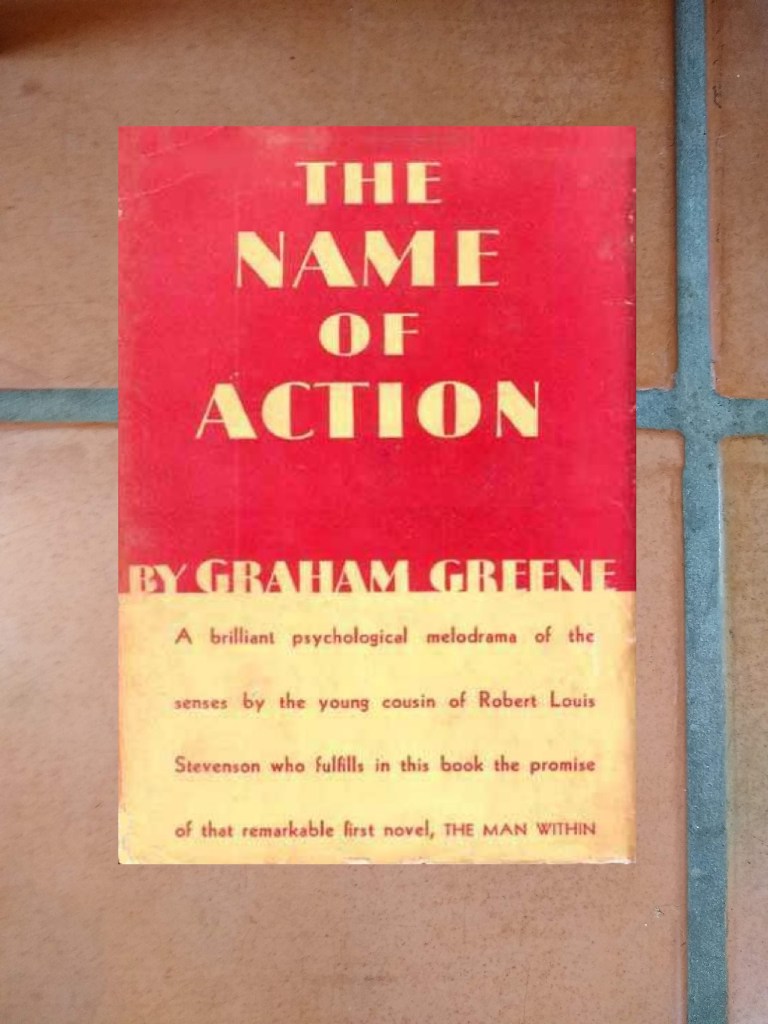
Published 1930
Green wrote this book in 1930. It was his second book and one of the two books that he later repudiated and never allowed to be republished. I read it out of sequence, because I wanted to read what he wrote about these two books in his autobiographies first. The book is a historical curiosity and, as Greene recognized, without literary merit. In fact, since these books were only published with runs of 1,500 each they are quite rare today. The Internet Archive has pdf copies of each book and so I read the version of The Name of Action available there.
The book jumps right into a story with characters that seem to come from nowhere and run around declaiming all of their boring thoughts before wandering off the scene. The protagonist is Oliver Chant, a rich young fop who funds political movements seemingly out of boredom. He hears from a refugee in London about the possibility of toppling the dictator of Trier. Will he help with funding to restore the Republic? When he sees a newspaper photo of Anne-Marie, the pretty young French wife of the dictator, he decides to go in person to Trier. After all, when they topple the dictator, what’s going to happen to Anne-Marie?
In Trier, he discovers that the leader of the opposition is Kapper, a Jewish poet, and that they have no plans to topple Demassener with violence, but only to propagandize to build up public support for the Republic. Chant also meets the Demasseners and falls ever more in love with Anne-Marie. After a surprising number of pages in which little happens, Chant takes over the revolutionary movement from Kapper, brings in rifles and machine guns from Koblenz, sleeps with Anne-Marie, and learns from her of the dictator’s impotence. When Kapper hears of this, he uses his poetic powers to “own” Demassener, who is then easily toppled. Chant is disgusted with everyone, even Anne-Marie, who is uninterested in a long-term relationship, and so he accompanies the dictator out of town, leaving Trier to the Jew and the French harlot.
*
Greene was correct to disown this book. It is a stinker. It reads like a wordy treatment for a grade-B movie from the 1930s. Greene often revised his books when they were republished and the fact that this was never republished means that the anti-Semitic language in it was never changed. Others of his early books contain examples of this, Orient Express and Brighton Rock being the most salient. WWII made the bizarre and petty tropes of Jews contained in this book, which were, I suppose, a common part of the speech of someone of his class and time sound outdated and embarrassing. This antisemitism makes certain passages of the book quite unpleasant to read.
In his autobiography, Greene mentioned that he went through a phase as a young man when he read Joseph Conrad nonstop. This book shows that influence, although without Conrad’s skill. The greatest problem with the book is that Greene presents the protagonist without irony. Oliver Chant is romantic and petulant and such an easily-shocked twit that it would have taken a good writer indeed to pull off an adventure story with this man-boy as the hero.
 Mad Scribble