Special Review: Graham Greene’s Children Books
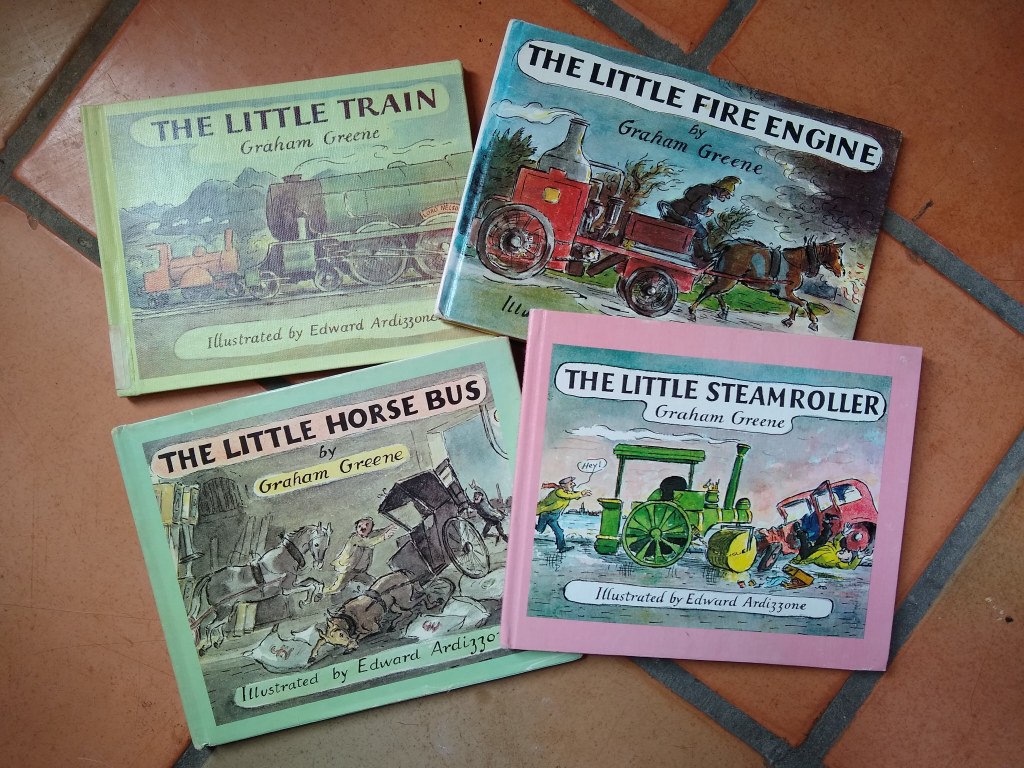
Published 1973-74
These are the most obscure books of Greene’s canon. They’re not hard to find: I bought these online for a few dollars each, but Greene doesn’t reference them in his autobiography* and they are unlike any of his other books. He published these four books in 1973 and 1974, when he was 69 and 70. My guess is that he wrote these for a grandchild. Each book is illustrated by Edward Ardizzone, whose style so exudes “children’s book” that I have to assume that I read as a child other books illustrated by him.
After reading these books, I remembered that Mad Magazine published a parody of them. The Wayward School Bus was a fifth children’s book by Graham Greene, excerpted in Mad, that discussed the precocious realization of sexuality and of moral relativity among a group of school children who waited for rescue after their school bus had run off the road. Aside from the inclusion of a vehicle in the title, these books are not at all like The Wayward School Bus. In fact, these are the most straight-forward of Greene’s books. They have little subtext, except an aversion to technological change, and they entertain and comfort the reader.
Each book focuses on some vehicle, anthropomorphized and with a big heart. Just the kind of strange creature that might appeal to a child. In each, the vehicle encounters some problem that it solves, demonstrating its hidden abilities and sense of moral clarity (such is the hero’s journey). The books don’t shy away from the economic struggle of adulthood. Both The Little Fire Engine and The Little Horse Bus involve people who are rendered redundant by the times, but whose vehicles save them from penury.
The Little Train
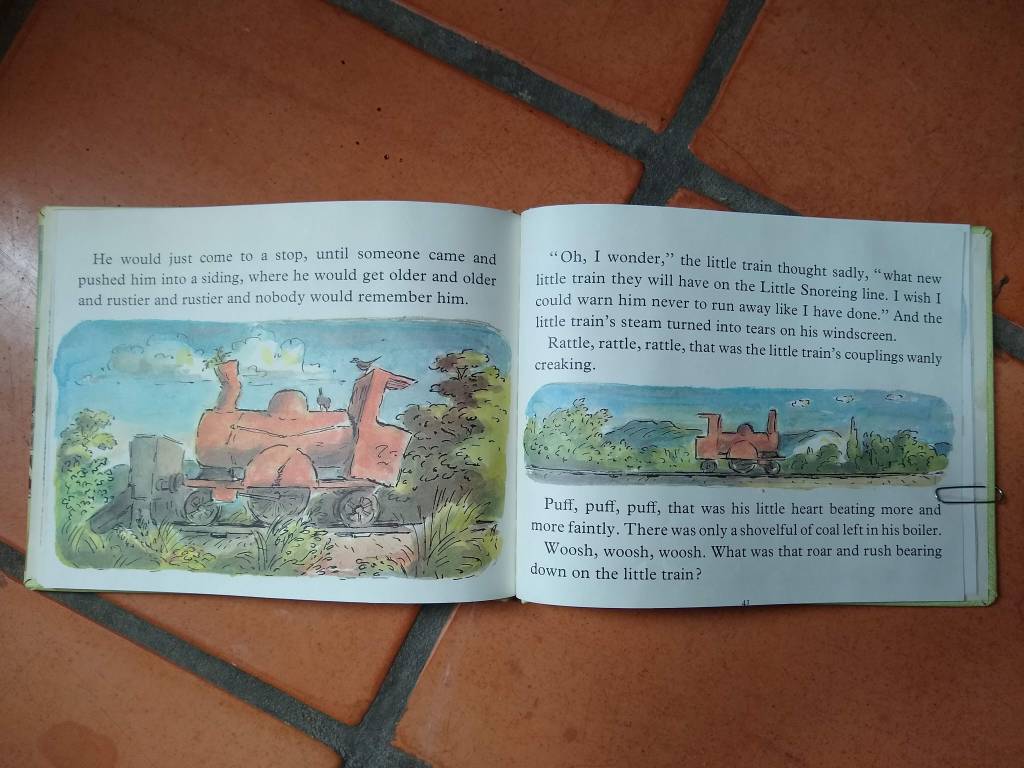
The little train lives in the sleepy village of Little Snoreing and every day runs the line between there to the market town of Much Snoreing. People visit Little Snoreing because of the beautiful and quiet countryside around it. Those that live along the line set their clocks by the train’s passing. But a whole world covered in tracks beckons to the little train. So, early one morning, he leaves his engine house and runs away.
By midday he has made it off the branch line and on to the express line. He passed through the city of Smokeoverall and under the shade of Gotobed Forest, through the Great Gloomy Mountains, where he began to feel lonely, and past the Knight’s Castle. Now he’s far from home and just about out of coal and water. What is he going to do? Is he going to rust away on some siding with memories of Little Snoreing as his only company?
The Little Fire Engine
We’re back in Little Snoreing. Sam Trolley is a fireman and has a steam-powered fire engine that is pulled by a pony, Toby. Sam is right not to trust Toby. But Sam’s troubles really begin when the evil Mayor of Much Snoreing writes to London and gets a modern fire engine and crew (complete with natty uniforms) sent to Little Snoreing. Sam is out of a job and can’t afford rent for his cottage, so he converts the Little Fire Engine into a sales cart and travels the country roads, trying to make a living selling housewares to farmsteads and in the villages. But by New Year’s Eve, Sam’s rheumatism keeps him from traveling, his money is running low, and Toby has run away. Sam is down to his last mince pie. Will Sam and the Little Fire Engine make it to the next year?

The Little Horse Bus
Mr. Potter had an old-fashioned grocery store. He employed three assistants, an errand boy, three cats, and a pony. He had a personal touch, doling out candy to children and taking the time to talk to his customers. But then the Hygienic Emporium (Limited) opened up across the street. The Emporium delivered its groceries in a hansom cab drawn by a fine chestnut mare. Mr. Potter soon finds himself with only children for customers, looking to buy candy. He has to layoff his assistants and his cats. His shop is redundant.
One day, when he can’t sleep because of hunger. He discovers an old, abandoned horse bus in the garage below his apartment. Thinking that delivering his groceries will bring his customers back, he hooks up the pony to the horse bus and has the errand boy deliver them. It doesn’t work. The hansom cab is much more respectable. But by reviving the horse bus, Mr. Potter has made a powerful ally…

The Little Steamroller
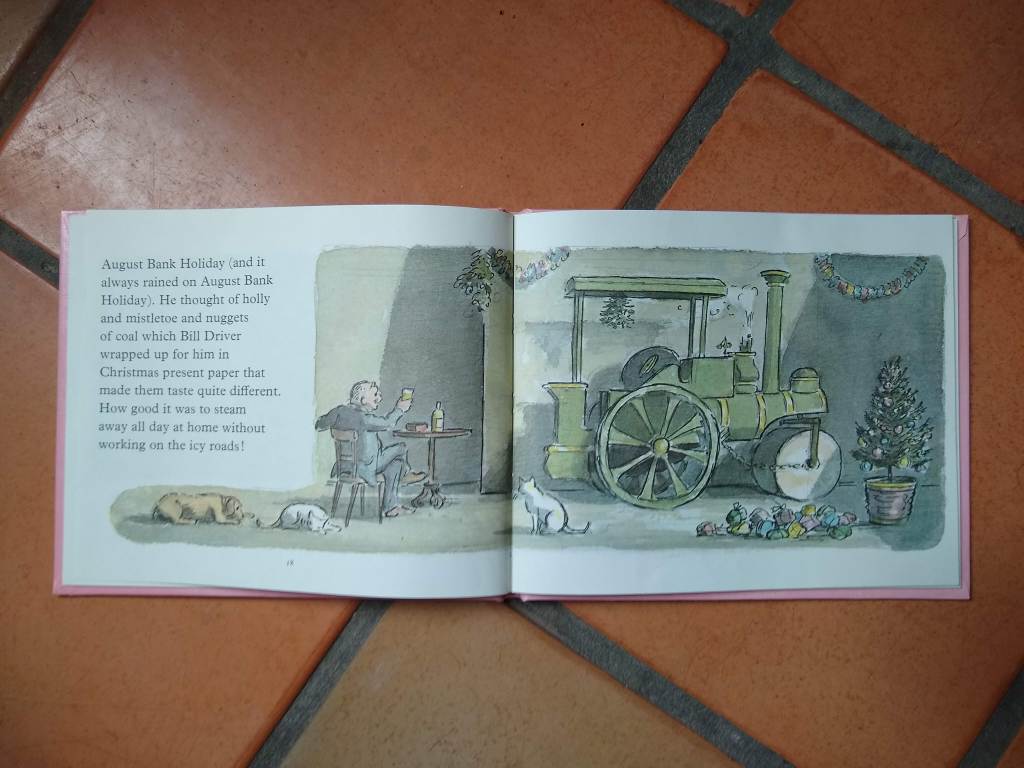
The previous three books seemed to take place in an idyllic version of the early 1900s; I presume modeled on the author’s childhood. This book is more contemporary, taking place in the London airport (Greene doesn’t specify which). The stakes are quite low in this book compared to the previous books. No one is looking down the gaping maw of hunger. All that is at risk is that someone might get away with smuggling gold into England and not pay customs. I know that when Greene worked in the intelligence services during WWII his primary goal was to prevent the smuggling of industrial diamonds to the Axis from Africa. Perhaps that informed him in writing this book and the smuggling he fought was a useful part of the war effort. On the other hand, this book would appeal to only children who believe in the importance of law-and-order or is intended to inculcate such a belief. Thank God steamrollers still know right from wrong!
*
These are strange books. The first three are not bad. The last is unnecessary. Either Greene wrote these books to match the interests of a particular grandchild or he was under the influence of some substance and thought it would be a good idea to write children’s books. The illustrations are good.
* Not quite true: He mentions spending time at a terrible seaside resort with Edward Ardizzone while they worked together illustrating some of his books.
 Mad Scribble