Getting to Know the General: The Story of an Involvement
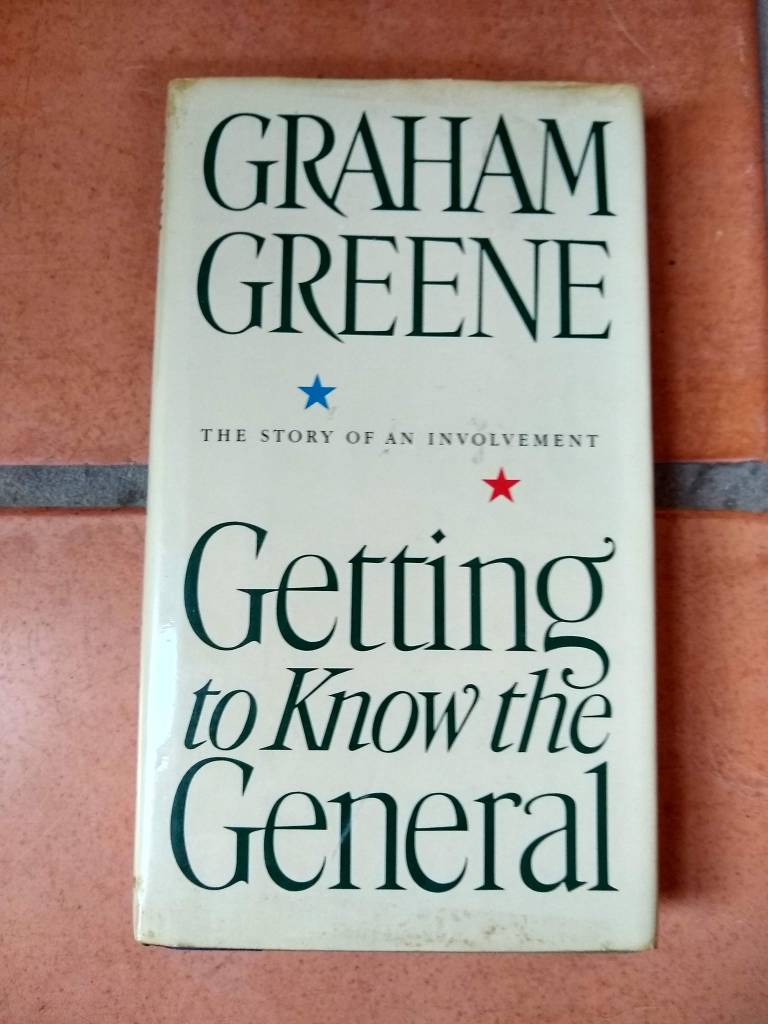
Published 1984
In the long list of “Books by Graham Greene” at the beginning of each of his books, from book to book Getting to Know the General flips between the “Autobiography” section and the “Travel” section. In the Foreword Greene describes the book as a memoir and the I think that that vague name is the most appropriate. This book describes the memories of his improbable sojourns in Panama. At times the book slips into journalism, of the gonzo kind since he was taking part in the newsworthy events he describes. It seems the most Greeneian of Greene books. A description of Greeneland as a real country: not the Panama of the almanac, unliving facts, or the newspaper headlines, sensationalism with an agenda, but a land whose rulers are complex souls: living, loving, and always aware of death. Graham Greene spent weeks each year living in this Greeneland, became friends with the men who ruled the country, traveled the land, witnessed the struggles of the city and country, and even traveled to Washington, DC and Managua as a representative of Panama.
I had never heard of General Omar Torrijos, the leader of Panama from 1968 to 1981. Under his rule, Panama signed the treaties with the USA that allowed for the return of the Panama Canal and Canal Zone to Panamanian sovereignty, although the canal would not return to the country until 1999. These treaties were unpopular in both Panama and the United States. This peaceful transfer of one of America’s colonial assets to its rightful owner could not have occurred without both Carter and Torrijos being the counterparties.
Torrijos invited Greene to Panama because (I presume) he thought that he could be a soft-power ally in Panama’s attempt to regain the Canal Zone. Greene was happy to be used in this fashion. Even more so after Greene became a close friend of the Panamanian general and his right-hand man Sergent Chuchu. He not only got to tour much of Panama, but he found himself involved in the politics of Central America during an exciting time, 1976-1983, with revolutionary movements in multiple countries and one, the Sandinistas, even succeeding. Greene had always been wary of both the United States-led West and the Soviet Union and he found the non-ideological approaches to governance by Torrijos, George Price of Belize and, a bit less so, by the Sandinistas to be refreshing.
But all of that is incidental in a memoir whose topic is Greene’s friendship for Torrijos and Chuchu. Greene’s peregrinations about Panama with Chuchu lead to many ridiculous moments, which Greene savored. Torrijos sent him as a Panamanian representative to Managua, after the Sandinistas took over, and to Belize. Although, in the latter case, Greene was not representing Panama: Torrijos simply thought that Greene would like Prime Minister Price, the leader of Belize. Greene toured the latter country with Price and the two did become friends.
In Managua, Greene toured the capital region with people whose acquaintance he had made in Panama a couple of years before, when they had found political shelter there. Although Greene was impressed with the Sandinistas, his description of Managua is not as effusive as his description of Panama. I think he doubted whether a revolution founded on an ideology could succeed in human dimensions.
Greene’s improbable foray into revolutionary politics in Central America is amusing. He went more gonzo than Hunter S. Thompson ever did. Along with Gabriel Garcia Marquez, he attended the signing of the one of the canal treaties in Washington, DC between Carter and Torrijos. Later on, he found himself called on to use his connections among Central American revolutionaries to facilitate the release of hostages held by rebel groups in the region.
*
Greene’s final trip to Panama was in January 1983, the year he turned 79. Visiting Panama had become painful after Omar Torrijos died when his helicopter crashed or blew up over the jungle. Why the helicopter crashed on a day with good weather has never been explained, although some evidence points to CIA involvement. Later on in the same year that Greene made his final visit, Manuel Noriega, a CIA protégé, became dictator of Panama. He would rule until 1989, when he had become inconvenient to US interests and the United States invaded Panama and arrested him.
 Mad Scribble